Lorwyn Eclipsed Review — Magic: The Gathering meets Jim Henson
Once more, with feeling

You may have noticed the playhead above! I’m creating an audio version of the newsletter for those more inclined to listen than read — I’m calling it Games with James and Son, as my cohost is my 5-month old baby, who you’ll hear cooing and jabbering away in the background.
Now, on to the main event!
Lorwyn Eclipsed, prereleasing this weekend, is as much a remake as it is a sequel.
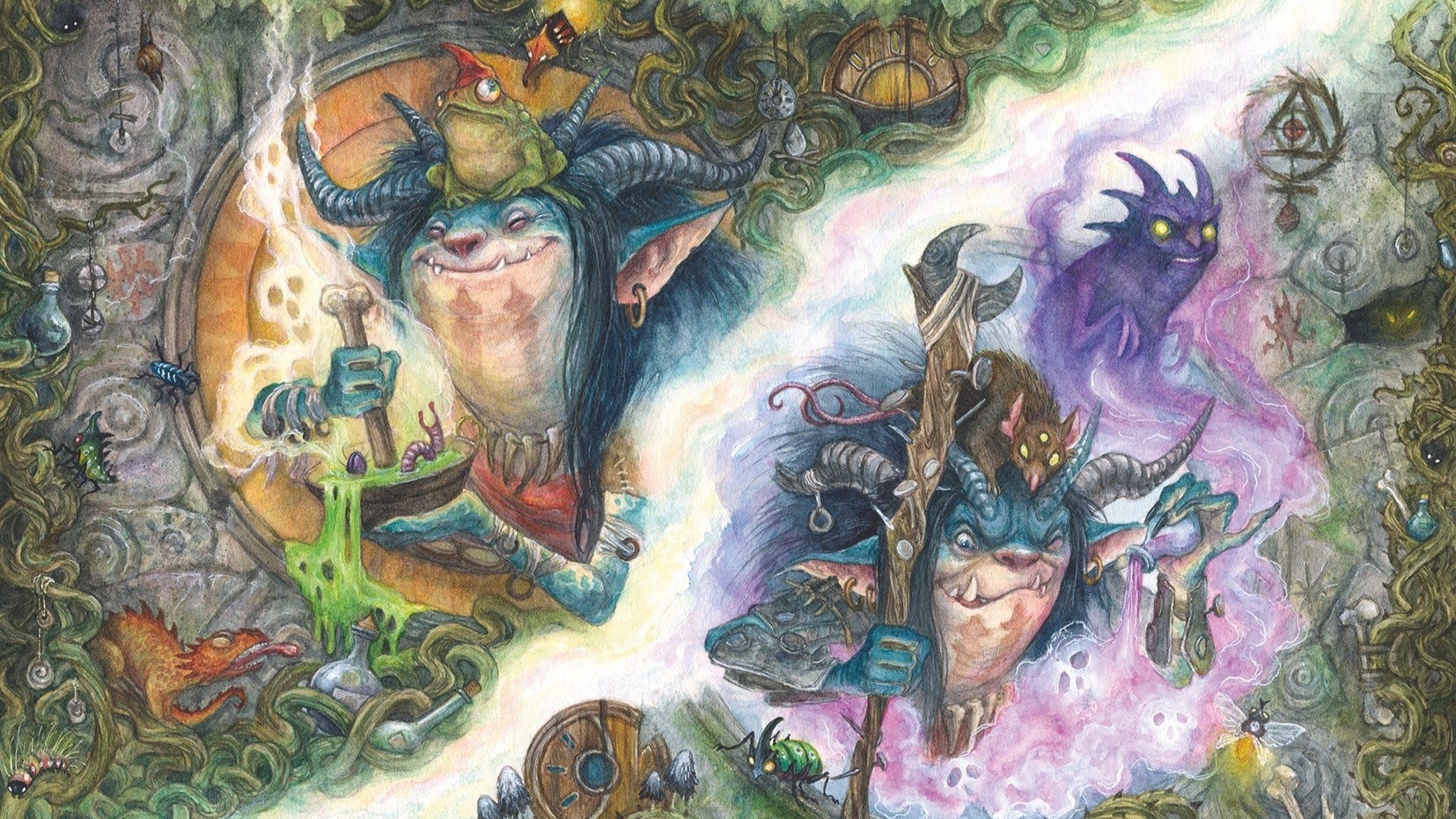
For nearly two decades, Magic: The Gathering designers downplayed the possibility of revisiting the idyllic plane and its dark twin, Shadowmoor. But after the success of other pastoral settings like Bloomburrow and Eldraine, gamemaker Wizards of the Coast scheduled Lorwyn Eclipsed between November’s Avatar: The Last Airbender product line and March’s Teenage Mutant Ninja Turtles crossover. Wizards even commissioned The Jim Henson Company to puppet a music video tied to the set’s release!
Lorwyn Eclipsed impressed me over the more than ten hours I drafted it in this week’s Magic: Arena Early Access event. Though its archetypes can feel a little narrow, it satisfyingly revisits a pivotal moment in the game’s history and reflects its recent acceleration towards higher complexity and power.

The original Lorwyn debuted in 2007 and marked a big shift for the trading card game. Bruised by the disappointing sales of the Time Spiral block, a trio of sets embraced by longtime fans for its mechanical intricacy and esoteric references, head designer Mark Rosewater tried to court new players with an initiative he dubbed the “New World Order.”
Rosewater’s team tried to make commons, the cards that make up a majority of a booster pack, more intuitive. They winnowed the rules text that had steadily made Magic more intimidating to learn. Lorwyn wasn’t always simple, but it was straightforward.
Lorwyn and its immediate sequel, Morningtide, doubled down on immediately-identifiable creature types. Its folksy world didn’t include any humans, but rather sported Elementals, Elves, Faeries, Giants, Goblins, Merfolk, Treefolk, and the hobbit-esque Kithkin. These “tribes” didn’t live in harmony, exactly, but neither did they engage in the constant warfare that so often afflicted Magic’s stories. That sunny vibe reversed in Shadowmoor, released in 2008, the year after Lorwyn.
Where Lorwyn focused on creature types, Shadowmoor and its sequel, Eventide, explored the five colors of Magic. Twisted by an eternal night brought on by a fae queen, the plane’s inhabitants turned hostile and paranoid, reverting to this most fundamental of game mechanics. A shared color identity strengthened some cards. Others punished anything outside of a color. Yet others worked differently depending on the color(s) of mana spent to cast them.

Lorwyn Eclipsed attempts to capture both sides of this dichotomy. All the classic creatures are back, but Goblins, Merfolk, Elves, Kithkin, and Elementals get more support than Faeries, Giants, and Treefolk. Changelings again serve as the “glue” between these strategies, since, as shapeshifters, they count as every creature type.
A new mechanic, vivid, evolves the color themes established by Shadowmoor. Borrowing its name from a cycle of Lorwyn lands, vivid gets stronger the more differently-colored permanents you control. Rather ingeniously, Lorwyn Eclipsed doesn’t make drafting all five colors easy. With only one common “fixing” land, you’ll have to rely on the set’s abundant hybrid cards to enable vivid.
Introduced in Ravnica but greatly expanded in the Shadowmoor sets, hybrid cards count as multicolor but can go into decks that share only part of their color identity. This means that you can rack up your vivid count without deviating far from a two-color archetype. Lorwyn Eclipsed features a common hybrid card for every color pair, and five of them are also changelings!
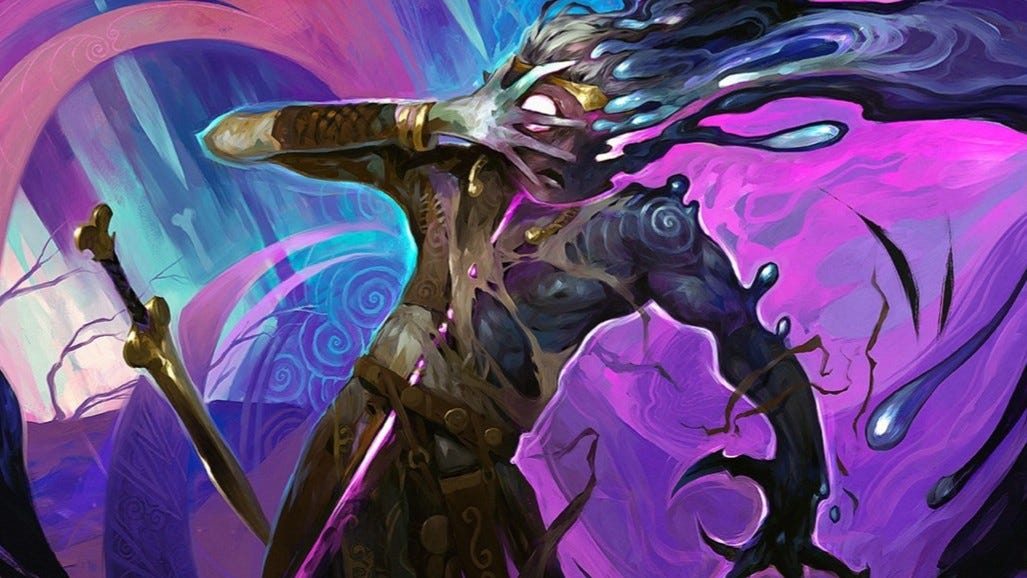
The resulting draft format feels flexible but lopsided. You’ll likely need to commit to one of the five main creature types, picking up changelings wherever you can. Most vivid cards are also elementals, pushing Blue-Red decks to verge into Green (the most abundant vivid color). Alternatively, you can defy the dominant creature archetypes, opting for more niche decks like White-Black counters or Blue-Black Faeries — but I only did this when motivated by a rare first pick.
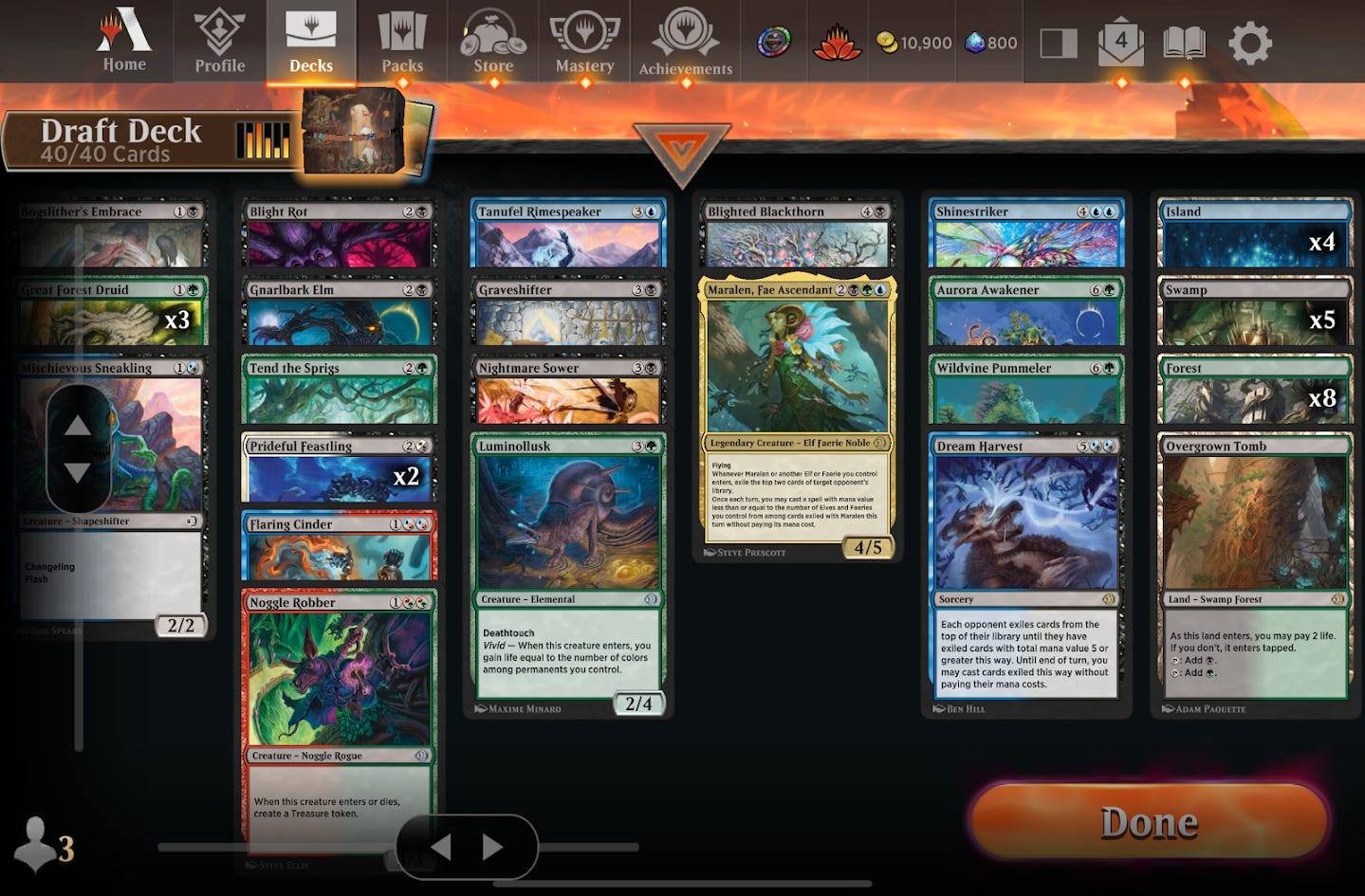
I had my most fun when I went wild with vivid, splashing Maralen, Fae Ascendant and abusing Aurora Awakener. But I was most successful when I committed to White-Blue Merfolk, convoking turn-three Merfolk Skywimmers thanks to turn-two Silvergill Mentors. Don’t get me wrong; I loved how quickly this deck could overwhelm opponents, but I felt like I’d exhausted the archetype’s potential after that draft. I fear the same disinterest could await the other four main archetypes, once I master them.
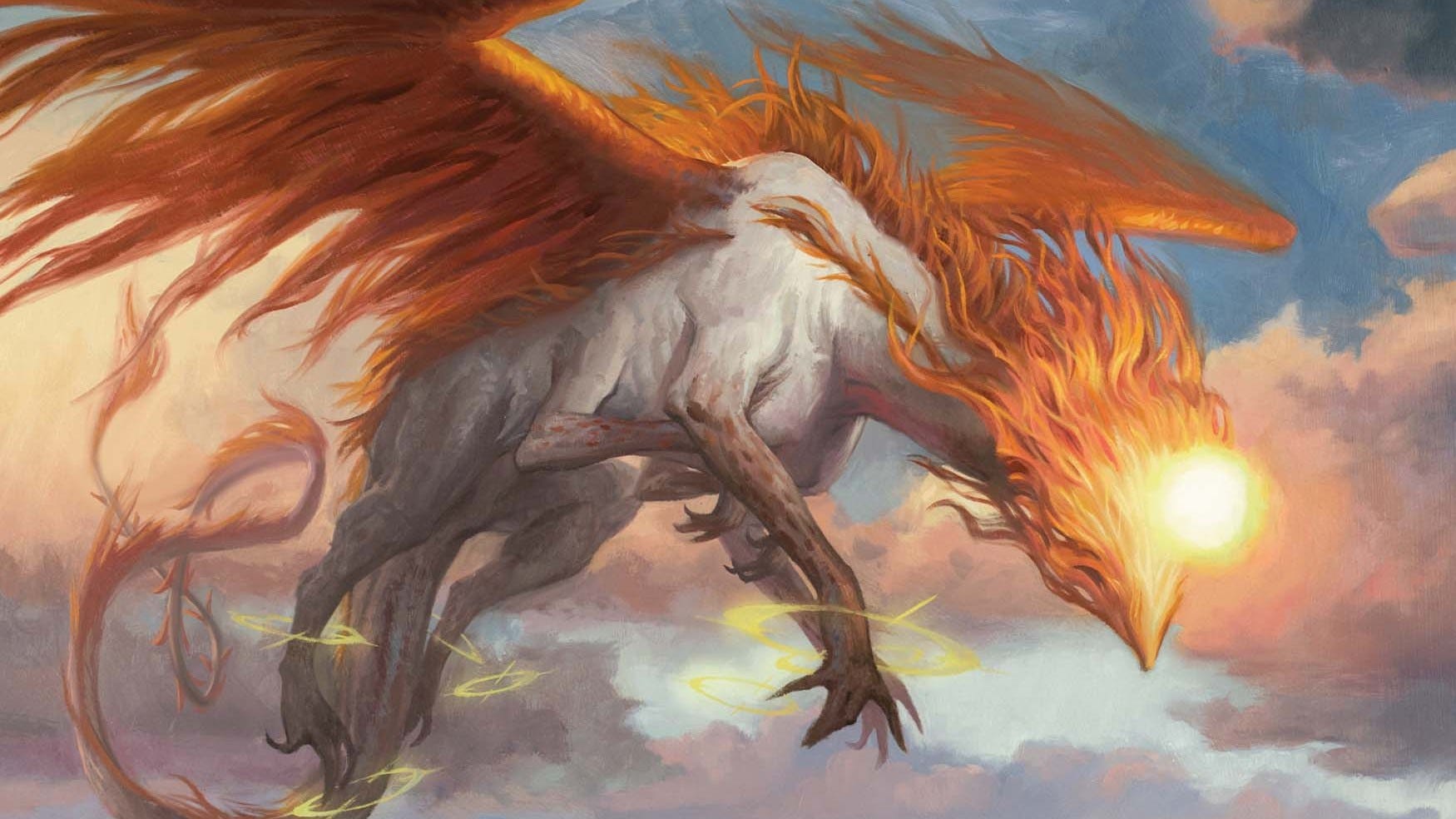
Granted, Lorwyn Eclipsed blurs the lines between decks a lot more than Bloomburrow, the last set that mostly hinged on creature types. Vivid cards and changelings add more mechanical elasticity to stretch the set’s staying power — and I’m also excited by its rares and mythics (particularly its cycle of Evoke cards). The set’s especially appealing for players who, like me, hazily recollect the old Lorwyn days, and want to experience them anew.
In some ways, however, Lorwyn has become what it once sought to correct. The original set prompted an era of reduced complexity, after the self-referential, baroque design of Time Spiral block. Its world was a back-to-basics synthesis of Celtic folktales and high fantasy. Lorwyn Eclipsed, meanwhile, is stuffed with references to past cards and the occasional counterintuitive interaction (an opponent expressed surprise at seeing me use Kirol to exile two creatures with Liminal Hold, for example). Its setting, once novel, now feels a little safe — a compilation album more than a bold new direction.
But I’m happy for Magic to play the hits when I’ve waited this long for the band to get back together. I’ll be jamming with the boggarts for weeks to come.
As a bonus for reading all that, here are screenshots of my two favorite decks from the Early Access event.
7-1 Merfolk!:
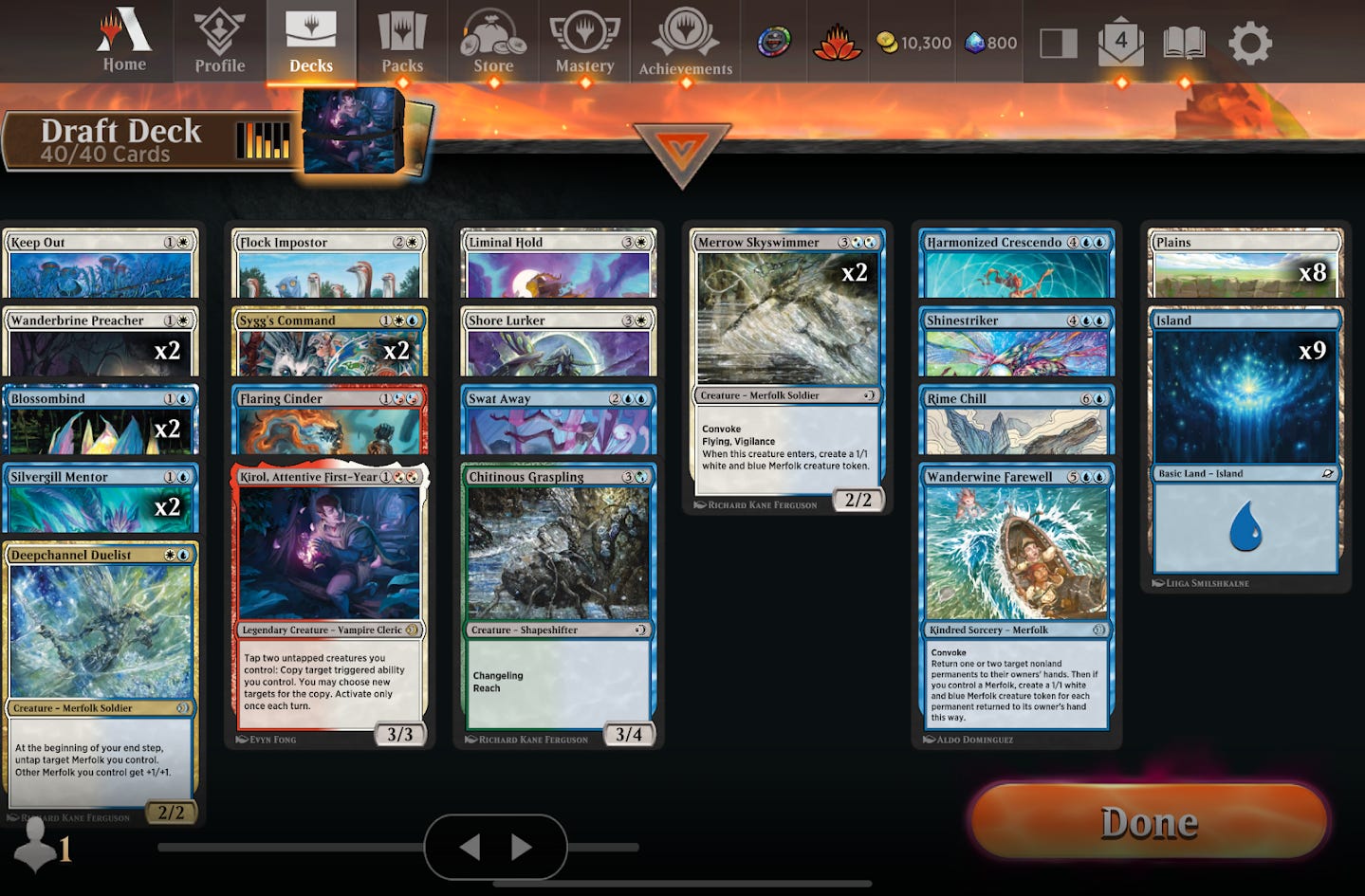
3-3 Aurora Awakener/Maralen. I think I could have done better had I not been rushing since the event was ending (also, baby was starting to wake up from naptime!):